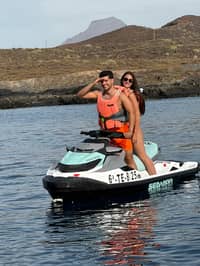
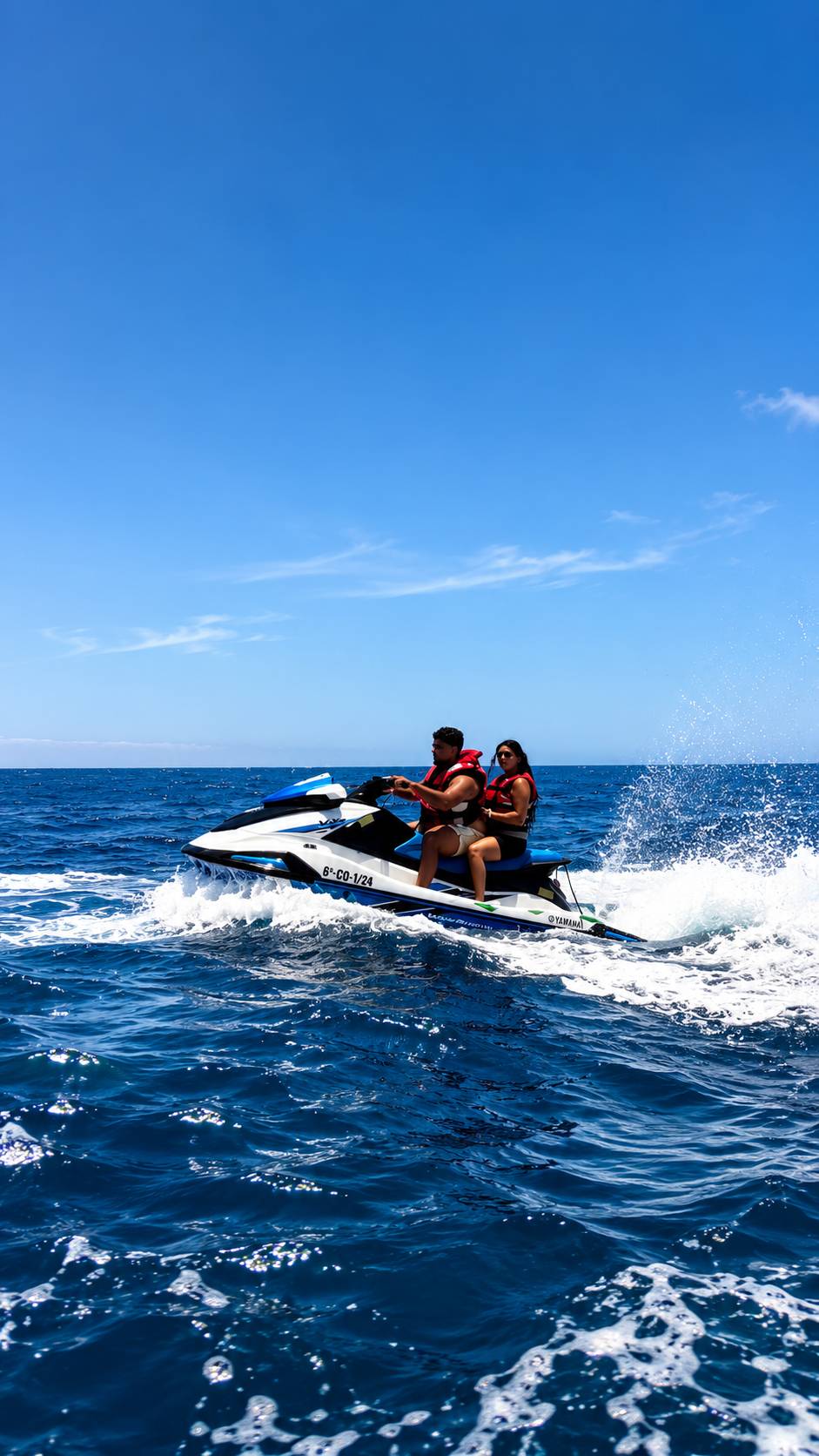
 No licence
Guides
Language
EnglishCurrency
US dollar · $GetYourGuide shows prices in the currency you choose.
Guide · Safety and rules
How dangerous are jet skis? Rules, age and licence in Tenerife
How dangerous are jet skis on a guided ride? Less than the noise suggests, as long as you know the rules, respect the limits and listen to the briefing.
Check availabilityfrom $47 · no cancellation fee
Editorial team, jetskisafaritenerife.comUpdated October 26, 2026Reading time 6 min29 sources
Where the real risks on a ride lie
Jet skis are fast, heavy and loud, and that is exactly why people love them. The risks are the obvious ones: hitting another craft, hitting a swimmer, and falling off at speed. On a guided ride in Tenerife, Spanish rules attack each of those directly, with fixed distances, a guide in charge of the formation, and riding zones kept away from beaches.
Falling off is what first-timers fear, and at moderate speed it is usually harmless. You land in the water, wearing a life jacket, and climb back on from the rear. Before you set off, ask the guide to show you the boarding step and the grab handle, so the move is familiar when you need it. Collisions are the serious risk, and the rules spend many lines on spacing. Health matters too: the ride booked on this site is not suitable for pregnant women, non-swimmers or people with back problems.
The rules also set who may ride and when. Rental craft on circuits and group excursions are capped at 60 hp.6 Riding is only allowed in good visibility and good weather, with prudence and without reckless behaviour.7 The harbour master can change riding times and zones, or stop riding for a while, when the weather or other safety reasons call for it.8
Safety, step by step
From booking to back on the pontoon
-
Before you go
Consent for teenagers
-
At the marina
The briefing
An instructor explains handling and basic rules first.10
-
Kitting up
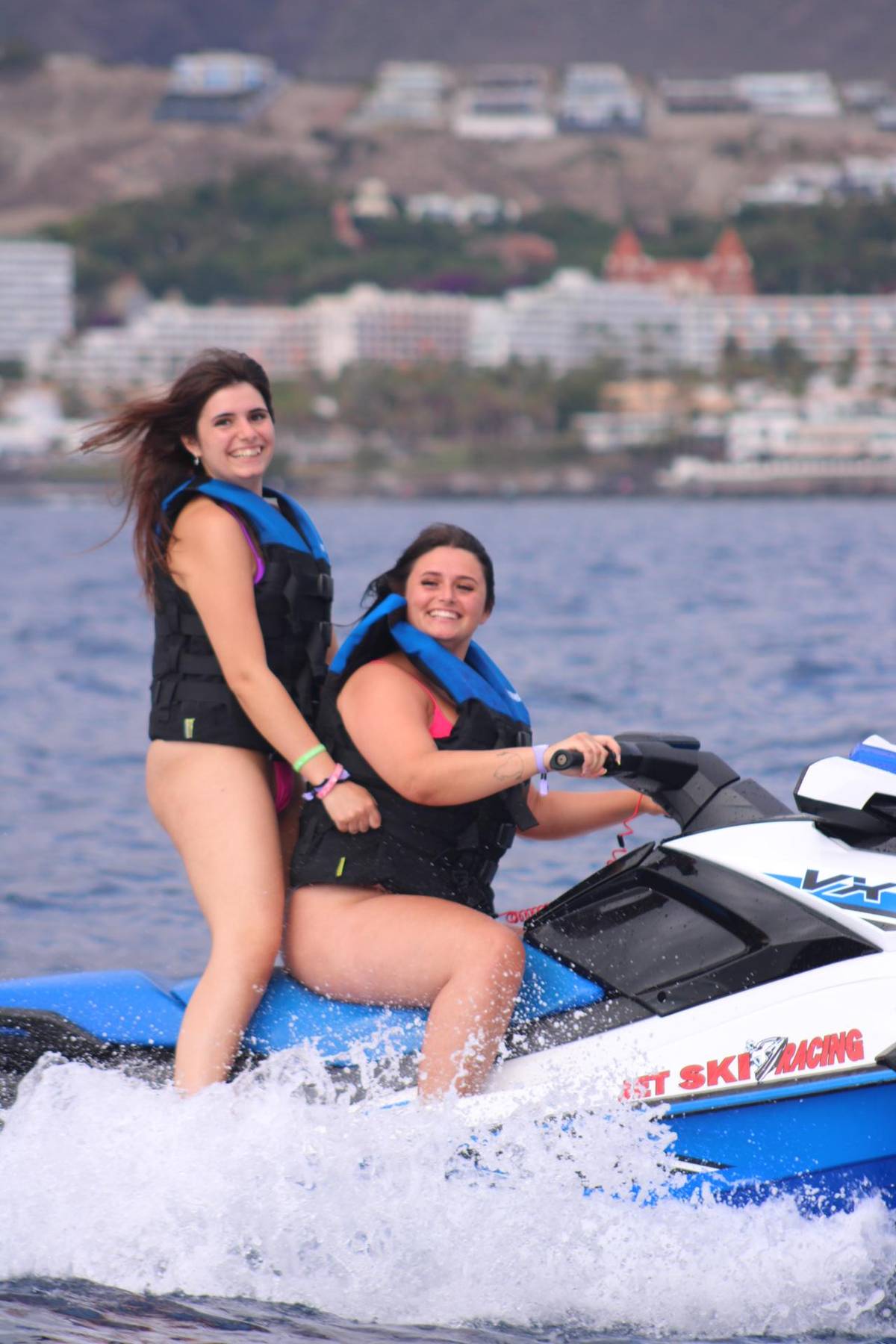
Life jacket on
Approved, with at least 100 N of buoyancy and a whistle.11
-
On the water
Hold the formation
Pairs behind the guide, at least 25 m apart.4
-
Coming back
Slow in the marina
A top speed of 3 knots in channels and marinas.12
Jet ski rules and regulations in Spain
The main jet ski rules and regulations in Spain sit in a royal decree on the safety of personal watercraft, published in the official state gazette. Companies may rent craft by the hour for group excursions, or for solo trips where a qualified instructor drives and you ride behind.13 On circuits and group excursions the rider needs no qualification.1 For private use you need a boating title, such as the basic navigation skipper title.14
Rental companies carry obligations of their own. They must hold accident insurance.15 They need a rescue boat or craft to move users, and at least 2 instructors, each watching at most 4 machines with at most 2 people aboard each.1617 They tell the local harbour master's office the route and approximate length of every excursion they sell, and keep a register of instructors and riders open to it.1819
Rental craft may not be beached or parked on the sand.20 Every craft carries a plate of basic rules: daylight only, a top speed of 3 knots in channels and marinas, a life jacket, and no approaching within 50 m of other craft, ships or boats.1221 On a group excursion, overtaking is not allowed.22 The deposit on the ride booked here exists to enforce exactly those distances.
The rules at a glance
What Spanish law asks of riders and operators
| Topic | The rule | Who it binds |
|---|---|---|
| Age | 18, or 16 with consent | Every driver |
| Licence | None on group excursions | Guided riders |
| Life jacket | 100 N, with a whistle | Driver & passenger |
| Power | Capped at 60 hp | Rental craft |
| Spacing | 25 m in a group, 50 m on a circuit | Every rider |
| Hours | Daylight, with an hour's margin | Every rider |
| Insurance | Accident cover | Rental companies |
Taken from the consolidated text of the Spanish royal decree on personal watercraft in the BOE, the state gazette; operators may set stricter limits.213116425515
Three ways onto the water
Buoy circuit, guided excursion or your own licence
No licence No licence
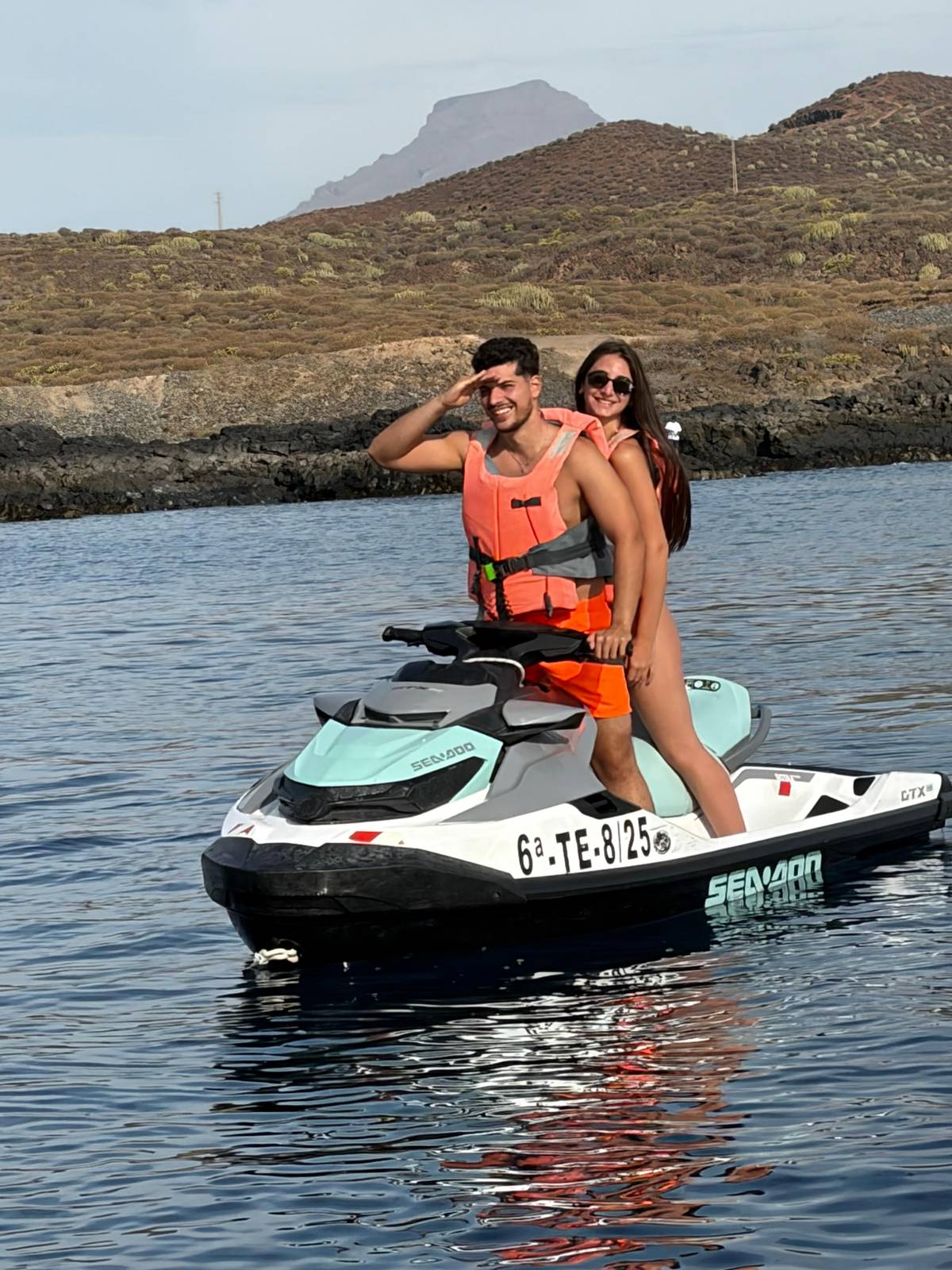 Licence needed
Decision helper
Is a jet ski ride right for you?
Check yourself against the rules before you book
Choose something else
The ride booked here is not suitable for non-swimmers.
Better not
The ride booked here is not suitable for people with back problems.
Users driving the craft must always keep the distances and formation the instructor has given them, and may not overtake one another.
Age, licence and consent, explained simply
Spanish law sets the minimum age to drive any personal watercraft at 18. Riders aged 16 or 17 may drive with the consent of their parents or guardians.2 The consent must be a signed document with a copy of the parent's ID card or passport, and the young driver must be able to show it at any moment.9 Print it at home; a marina is no place to go looking for a printer.
Operators can be stricter than the law, never looser. The ride booked here accepts drivers from 16, with written consent for 16 and 17-year-olds, and passengers from 8 who can hold on to the driver. Some tours ask for 18 whenever a passenger rides behind, and one buoy circuit asks for 18 to drive at all. The ride booked here also sets a maximum age of 70.
Do you need a licence? Not on a guided excursion. To ride alone for private use, the lightest option is a navigation licence issued by sailing and motorboating federations or nautical schools.26 It covers daytime trips within 2 nautical miles of a port, marina or shelter.27 For a holiday ride, the guided excursion is the simple and legal way onto the water.
Checklist
A first-timer's safety list
01
Before
- Signed consent for drivers aged 16 or 17
- Ask about hand signals and restarting
- Life jacket fastened and snug
02
On the water
- Keep the gap your guide sets
- Gentle throttle, especially at first
- Fall off? Climb on from the rear
Video
How to drive a jet ski as a beginner
This player stays empty, and YouTube unasked, until you start the clip.
How to jet ski for beginners
If you are learning how to jet ski for beginners, the first lesson is the briefing. Spanish rules require one from an instructor before anyone uses the machines, covering handling and the basic rules of navigation, and long enough for you to take them in.10 Ask about anything you did not catch: what the hand signals mean, how to stop, and how to restart after a fall.
On the water, sit centered with your feet planted and knees soft. Squeeze the throttle gently; these machines answer fast, and a heavy hand is what throws riders off. Remember that a jet ski steers with thrust, so if you let go of the throttle in a turn the machine keeps going straight. Look where you want to go, not at the water right in front of you. When a wave comes, take it slightly at an angle with a little throttle on rather than braking hard; the hull rides over it, and you stay seated.
Hold your place in the group. Group excursions run preferably with 1 instructor ahead of 4 craft in pairs, like an arrowhead, at least 25 m apart.4 Keep the gap your guide sets, never overtake, and watch the guide rather than the scenery when the group changes direction.22 The views will wait for the stops.
Where you may ride, and when
Beaches are off limits. Personal watercraft may not enter buoyed bathing zones and must use marked launch channels at the ends of beaches, at no more than 3 knots.28 Where no bathing zone is marked, riding is banned in the 200 m strip next to the shore, except to reach or leave a beach at right angles at no more than 3 knots.24
Riders on an hourly circuit without a licence stay inside the 4 buoys, all going round in the same direction, at least 50 m apart.25 On the coast, the guide leads and the formation keeps you clear of other boats. Riding is allowed only in daylight, from 1 hour after sunrise to 1 hour before sunset.5
Wildlife has its own rules. Spanish law sets an exclusion zone of at least 60 m around any whale or dolphin.23 If cetaceans appear closer than that, the engine goes into neutral at low revs, or is stopped.29 If your group suddenly slows and drifts, that may be the reason, and the right thing is to sit still and enjoy the moment.
Who should think twice before booking
Some people should choose a different day out. The ride booked here is not suitable for children under 8, pregnant women, non-swimmers, people over 118 kg or people with back problems. Another listing adds heart problems to that list and recommends that riders know how to swim. Alcohol and drugs are ruled out on every listing that mentions them.
Weight limits are there for stability. The ride booked here allows 200 kg on one jet ski and does not recommend it for riders over 120 kg. Others set lower combined limits for 2 riders, from about 160 kg. Be honest about these numbers when you book; an overloaded machine handles badly.
Nerves alone are no reason to skip it. Start with the shorter option of 40 minutes, sit behind a confident driver, or try a buoy circuit first. Tell your guide you are new and ask for an easy pace at the start. Fear tends to fade once the first stretch of open water is behind you.
Your hour at sea
Follow the guide boat along the volcanic coast.
40 minutes or 1 hour, no licence needed, and free to cancel until 24 hours before.


You ask,we answer.
Do I need a licence to ride a jet ski in Tenerife?
Not on a guided excursion. No qualification is required on circuits and group excursions; private use needs a boating title.114
What is the minimum age to drive?
18, or 16 with consent. Drivers of 16 or 17 need the signed consent of a parent or guardian, with a copy of their ID.29
Is a life jacket compulsory?
Yes, for everyone aboard. Driver and passenger must both wear an approved life jacket with a whistle.311
How far apart do riders stay?
At least 25 m in a group. Group excursions ride in pairs behind the instructor, with the instructor setting the gap.4
Can I ride close to the beach?
No. Bathing zones are off limits, and where none is marked the 200 m strip by the shore is too.2824
Can I ride at sunset?
Not in the last hour. Riding is allowed from 1 hour after sunrise to 1 hour before sunset.5
Sources
What this guide is based on
- 1Boletín Oficial del Estado (BOE), Spanish GovernmentReal Decreto 259/2002, safety measures for the use of personal watercraft (consolidated text)↩
- 2Boletín Oficial del Estado (BOE), Spanish GovernmentReal Decreto 259/2002, safety measures for the use of personal watercraft (consolidated text)↩
- 3Boletín Oficial del Estado (BOE), Spanish GovernmentReal Decreto 259/2002, safety measures for the use of personal watercraft (consolidated text)↩
- 4Boletín Oficial del Estado (BOE), Spanish GovernmentReal Decreto 259/2002, safety measures for the use of personal watercraft (consolidated text)↩
- 5Boletín Oficial del Estado (BOE), Spanish GovernmentReal Decreto 259/2002, safety measures for the use of personal watercraft (consolidated text)↩
- 6Boletín Oficial del Estado (BOE), Spanish GovernmentReal Decreto 259/2002, safety measures for the use of personal watercraft (consolidated text)↩
- 7Boletín Oficial del Estado (BOE), Spanish GovernmentReal Decreto 259/2002, safety measures for the use of personal watercraft (consolidated text)↩
- 8Boletín Oficial del Estado (BOE), Spanish GovernmentReal Decreto 259/2002, safety measures for the use of personal watercraft (consolidated text)↩
- 9Boletín Oficial del Estado (BOE), Spanish GovernmentReal Decreto 259/2002, safety measures for the use of personal watercraft (consolidated text)↩
- 10Boletín Oficial del Estado (BOE), Spanish GovernmentReal Decreto 259/2002, safety measures for the use of personal watercraft (consolidated text)↩
- 11Boletín Oficial del Estado (BOE), Spanish GovernmentReal Decreto 259/2002, safety measures for the use of personal watercraft (consolidated text)↩
- 12Boletín Oficial del Estado (BOE), Spanish GovernmentReal Decreto 259/2002, safety measures for the use of personal watercraft (consolidated text)↩
- 13Boletín Oficial del Estado (BOE), Spanish GovernmentReal Decreto 259/2002, safety measures for the use of personal watercraft (consolidated text)↩
- 14Boletín Oficial del Estado (BOE), Spanish GovernmentReal Decreto 259/2002, safety measures for the use of personal watercraft (consolidated text)↩
- 15Boletín Oficial del Estado (BOE), Spanish GovernmentReal Decreto 259/2002, safety measures for the use of personal watercraft (consolidated text)↩
- 16Boletín Oficial del Estado (BOE), Spanish GovernmentReal Decreto 259/2002, safety measures for the use of personal watercraft (consolidated text)↩
- 17Boletín Oficial del Estado (BOE), Spanish GovernmentReal Decreto 259/2002, safety measures for the use of personal watercraft (consolidated text)↩
- 18Boletín Oficial del Estado (BOE), Spanish GovernmentReal Decreto 259/2002, safety measures for the use of personal watercraft (consolidated text)↩
- 19Boletín Oficial del Estado (BOE), Spanish GovernmentReal Decreto 259/2002, safety measures for the use of personal watercraft (consolidated text)↩
- 20Boletín Oficial del Estado (BOE), Spanish GovernmentReal Decreto 259/2002, safety measures for the use of personal watercraft (consolidated text)↩
- 21Boletín Oficial del Estado (BOE), Spanish GovernmentReal Decreto 259/2002, safety measures for the use of personal watercraft (consolidated text)↩
- 22Boletín Oficial del Estado (BOE), Spanish GovernmentReal Decreto 259/2002, safety measures for the use of personal watercraft (consolidated text)↩
- 23Boletín Oficial del Estado (BOE), Spanish GovernmentReal Decreto 1727/2007, protection measures for cetaceans (consolidated text)↩
- 24Boletín Oficial del Estado (BOE), Spanish GovernmentReal Decreto 259/2002, safety measures for the use of personal watercraft (consolidated text)↩
- 25Boletín Oficial del Estado (BOE), Spanish GovernmentReal Decreto 259/2002, safety measures for the use of personal watercraft (consolidated text)↩
- 26Boletín Oficial del Estado (BOE), Spanish GovernmentReal Decreto 875/2014, nautical qualifications for recreational craft (consolidated text)↩
- 27Boletín Oficial del Estado (BOE), Spanish GovernmentReal Decreto 875/2014, nautical qualifications for recreational craft (consolidated text)↩
- 28Boletín Oficial del Estado (BOE), Spanish GovernmentReal Decreto 259/2002, safety measures for the use of personal watercraft (consolidated text)↩
- 29Boletín Oficial del Estado (BOE), Spanish GovernmentReal Decreto 1727/2007, protection measures for cetaceans (consolidated text)↩