 Sunniest
Guides
Language
EnglishCurrency
US dollar · $GetYourGuide shows prices in the currency you choose.
Guide · Best time
The best time for a jet ski in Tenerife: months, sea and wind
The best time for a jet ski in Tenerife is any month with a calm morning. Here is what AEMET's figures say about the year, and how to pick the right day within your week.
Check availabilityfrom $47 · no cancellation fee
Editorial team, jetskisafaritenerife.comUpdated October 26, 2026Reading time 6 min11 sources
In brief
- 01All year
- The south coast keeps summery weather year-round.1
- 02Sea warmth
- Between 19 and 26 °C across the year.2
- 03Sunniest month
- July averages 295 hours of sunshine at Tenerife Sur.3
- 04Wettest month
- December averages 30 mm of rain.4
- 05Time of day
- Daylight only, 1 hr after sunrise to 1 hr before sunset.5
The short answer: any month, but not any day
Tenerife's south coast is a year-round place to ride. Turismo de Tenerife says the island's mountains shield the south from the trade-wind clouds, which keeps summery weather all year, above all on the coast.1 It also describes the south as drier than the north, with longer daylight hours.6 That is the side of the island where the marinas for these rides lie.
AEMET's normals for its Tenerife Sur airport station, 64 m up on the south coast, show how mild the range is.7 The average high is 21.7 °C in January and 28.4 °C in August; the average low is 15.2 °C in January and 21.1 °C in August.83 There is no month in which a ride is out of the question on climate alone.
What does change is the sea from one day to the next. A calm morning in February beats a choppy one in July, and the best time for a jet ski is really the best day of your trip. Put the ride near the start of your trip, note when free cancellation ends, and shift it if the wind rises; that morning's forecast outweighs the month.
Your riding day
From the forecast to the shower
-
The evening before
Read the forecast
Look at wind and swell for the south coast, then decide.
-
Up to a day ahead
Move if needed
Cancel free up to 24 hours before on the ride booked here.
-
At the marina
Arrive early
Meet 30 minutes before the booked time at San Miguel.
-
On the water
Daylight only
Riding runs from 1 hour after sunrise to 1 hour before sunset.5
-
Afterwards
Rinse and warm up
A shower and toilet stand close to the base.
Month by month on the south coast
Winter is the mildest of winters. From December to February the average high at Tenerife Sur sits between 21.7 °C and 22.8 °C, and the average low around 15 °C to 16.5 °C.84 Rain falls on a few days only: December averages 30 mm, January 17 mm and February 20 mm.48 Sunshine runs at 193 to 195 hours a month.84
Spring warms up slowly and dries out. March and April both average highs of 23.1 °C, May 23.9 °C, and the rain drops from 15 mm in March to 1 mm in May.83 Sunshine climbs from 226 hours in March to 246 in May.83 It is a comfortable season for riding: warm enough to dry off quickly, rarely hot at midday. If you travel at Easter or in early spring, this is also when the long evenings start to return, and an afternoon slot feels less rushed.
Summer is the sunniest stretch. June averages 259 hours of sunshine, July 295 and August 277, with practically no rain, 0 mm in June and July and 1 mm in August.3 Highs reach 27.7 °C in July and 28.4 °C in August.3 Autumn stays warm, with highs of 27.9 °C in September and 26.8 °C in October, before rain returns in November with 26 mm.4
Month by month
Daylight and rain at Tenerife Sur
Hours without sunDays with precipitationSeason
Seasons compared
The riding year on the south coast
| Season | Average high | Sunshine a month | Rain a month |
|---|---|---|---|
| Winter | 21.7 to 22.8 °C | 193 to 195 hrs | 17 to 30 mm |
| Spring | 23.1 to 23.9 °C | 219 to 246 hrs | 1 to 15 mm |
| Summer | 25.4 to 28.4 °C | 259 to 295 hrs | 0 to 1 mm |
| Autumn | 24.8 to 27.9 °C | 193 to 214 hrs | 4 to 26 mm |
AEMET standard climate values 1981 to 2010 for Tenerife Sur airport, 64 m; winter is December to February, and so on.7834
Three kinds of riding day
Summer sun, winter calm or a breezy day
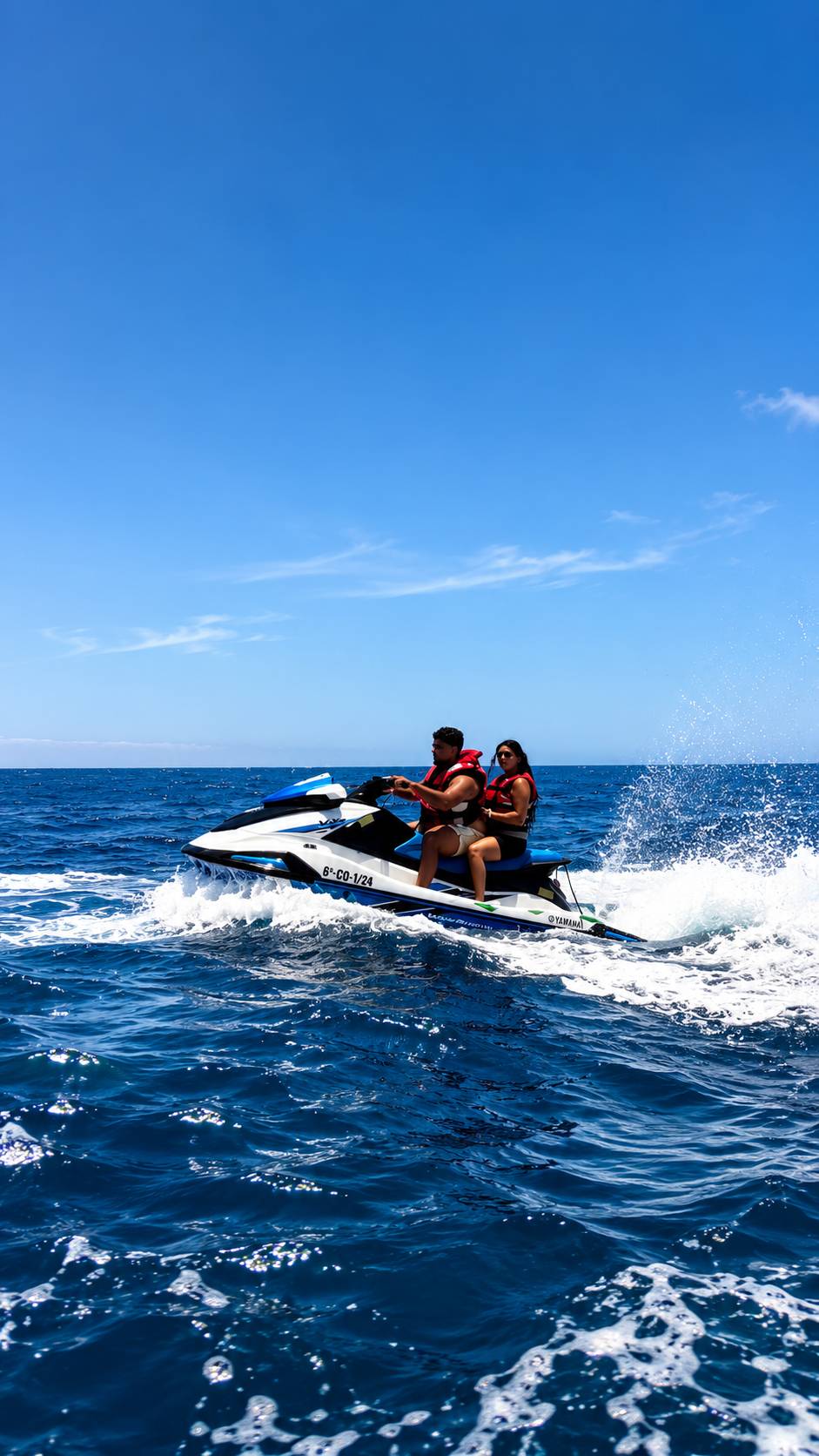
Sunniest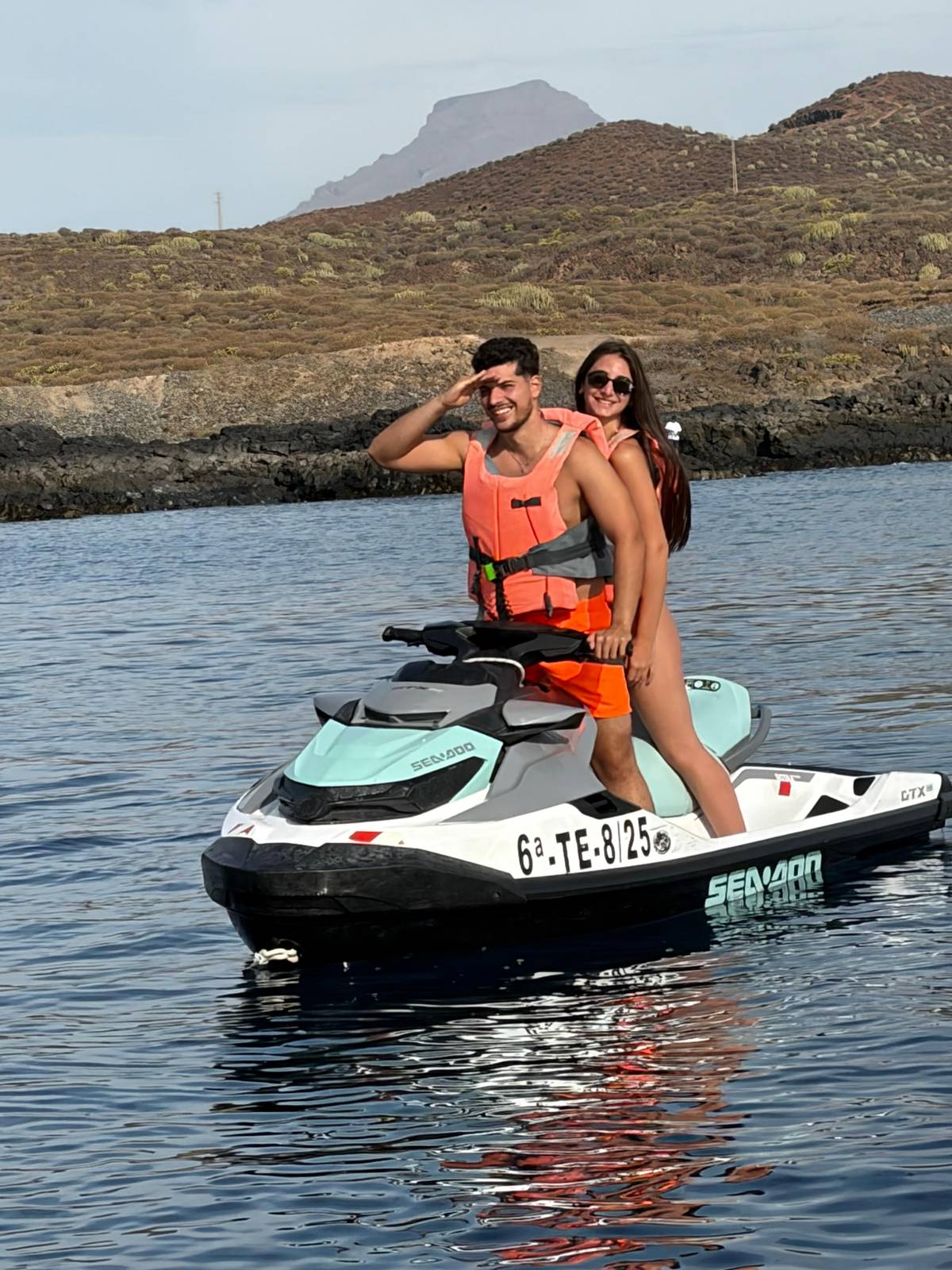 Mildest air
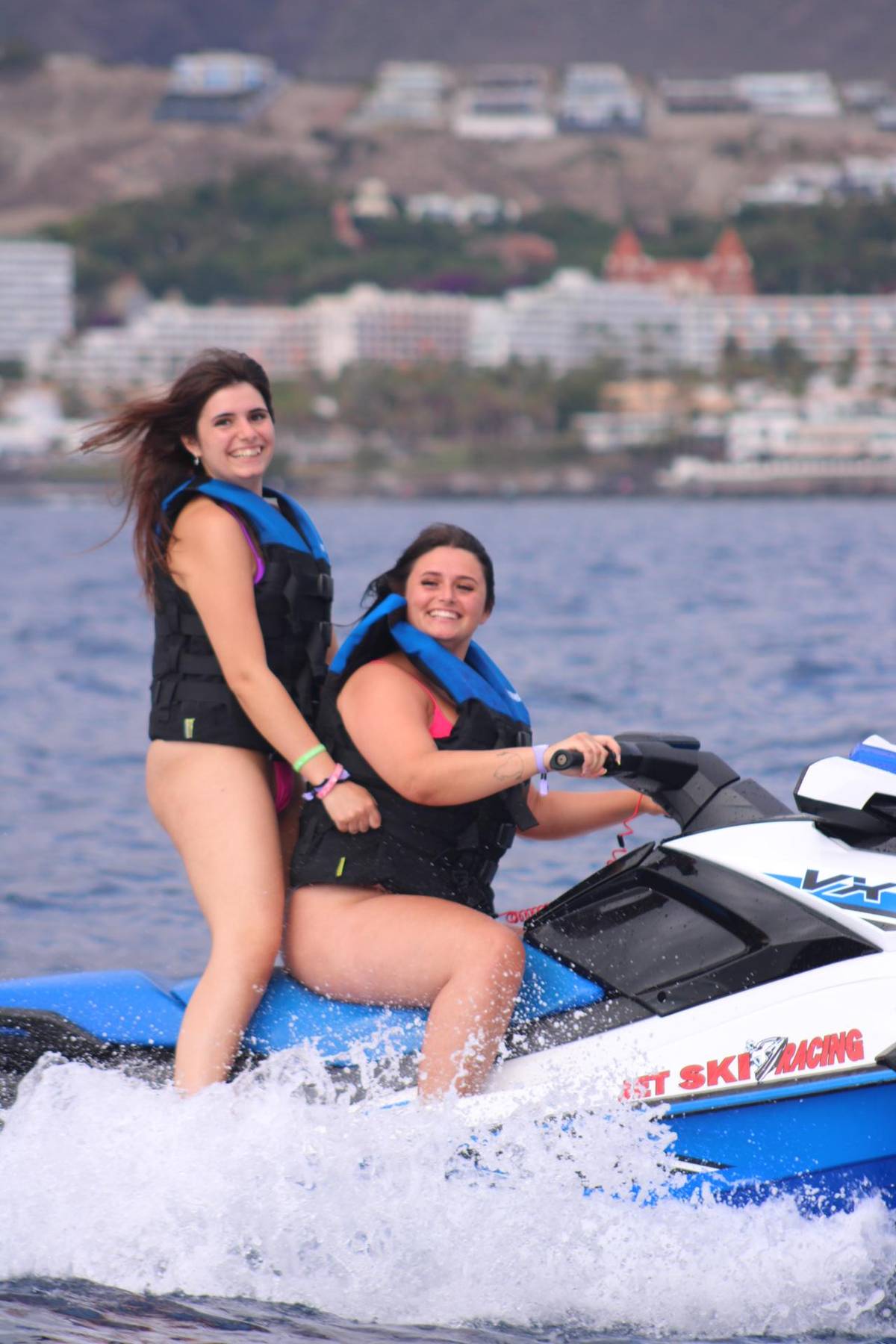 Bumpy ride
Decision helper
When should you book your ride?
Match the ride to your season and your nerves
July
It averages 295 hours of sunshine at Tenerife Sur.3
Ride anyway
January highs average 21.7 °C on the south coast.8
Ask for a wetsuit
The safari booked here lends one if you need it.
Move the day
Cancel free up to 24 hours before on the ride booked here.
An afternoon slot
Riding is allowed until 1 hour before sunset.5
Tenerife's mountains protect the south of the Island from these clouds, ensuring summery weather all year round, especially on the coast.
Sea temperature, and whether you will be cold
Turismo de Tenerife gives the sea temperature around the island as ranging from 19 to 26 degrees across the year.2 On a jet ski you spend most of the time on top of the water rather than in it, but spray, a swim stop or a tumble will get you wet, and the wind of your own speed cools you down faster than the thermometer suggests.
In summer and early autumn, swimwear and a light top are plenty. In winter, a dry layer helps before and after the ride. The safari booked on this site lends a wetsuit if you need one, along with the life jacket and goggles it includes anyway. Ask for it at the briefing if you feel the cold easily; it costs nothing to say so.
Air temperature after the ride matters too. With winter lows around 15 °C at Tenerife Sur, a towel and a warm top for the walk back to the car make a real difference.8 The safari booked here has a shower and toilet close to the base, so you can rinse off the salt before you change.
Checklist
Choosing your riding day
01
The day before
- Check the marine forecast
- Note your cancellation deadline
- Pick a morning or afternoon slot
02
By season
- Winter: a warm top for afterwards
- Summer: sun cream and sunglasses
- Any month: a towel and water
Video
Canary Islands temperatures and the best time to visit
This player stays empty, and YouTube unasked, until you start the clip.
Wind, swell and the rules on bad weather
The trade winds shape Tenerife's weather, pushing clouds against the mountains of the north; the same mountains keep much of that weather off the southern coast.1 On the water, though, wind and swell come and go with the Atlantic. A ride on a breezy day can be bumpy and exciting rather than dangerous, but in strong wind a ride can be shortened, moved or called off.
Spanish rules require good visibility and good weather for riding.9 The harbour master can change riding times and zones, or ban riding for a while, when the weather or other safety reasons call for it.10 Operators adapt too: the route of the safari booked here depends on the weather, and the Las Galletas and Los Gigantes operators offer a new date or a full refund if bad weather cancels the ride.
If you are prone to seasickness or simply nervous, choose a calm morning and the shorter option of 40 minutes. A choppy sea tires the arms and the back faster than a flat one. If you love speed, a little swell adds jumps and spray. Either way, read the wind and swell the night before, and know your cancellation deadline. A short message to the operator asking how the sea looks is a perfectly normal question, and the answer tells you more than any monthly average.
Morning or afternoon: daylight and timing
Riding is only allowed in daylight, from 1 hour after sunrise to 1 hour before sunset.5 On Tenerife daylight is longest in June, 13.9 hours at mid-month by our own calculation, and shortest in December, 10.4 hours, and the riding window is 2 hours shorter than the daylight.11 Even in winter there is plenty of room for a morning or afternoon slot.
Riding in the morning frees up the afternoon, and the briefing goes in more easily before the midday heat. An afternoon ride suits late risers and photographers who like a lower sun on the water. On the west coast, the cliffs at Los Gigantes catch the afternoon light. Ask the operator which slots they run on your date; times vary with the season.
Put the ride in the first half of your holiday. If the sea is rough on your chosen day, you then have time to rebook without rushing. Cancelling the safari booked here is free until 24 hours ahead, and you pay after reserving, so moving the date is painless.
How to pick your day in practice
Start with the week, not the month. Whatever season you travel in, the climate will not stop you; the sea state on the day decides. Check a marine forecast the evening before and look at the wind arrows for the south coast. Light wind from the land side usually means flatter water close to shore, and a calmer first ride.
Keep a back-up morning free. Book your preferred day, note the cancellation deadline, and if the forecast turns, move to the back-up rather than gambling on the morning itself. A calm sea on the back-up day is worth far more than sticking to the original plan.
Finally, match the season to your plans. Summer, from June to August, is the sunniest and driest, with 259 to 295 hours of sunshine a month.3 Winter is cooler on land but just as rideable, and the water still sits within the island's range of 19 to 26 degrees.2 Pack for the season, and pick the calmest morning of your trip.
Your hour at sea
Follow the guide boat along the volcanic coast.
40 minutes or 1 hour, no licence needed, and free to cancel until 24 hours before.


You ask,we answer.
What is the best month for a jet ski in Tenerife?
Any month with calm water. July is the sunniest, with 295 hours at Tenerife Sur, but the sea on the day matters more.3
Can I ride a jet ski in Tenerife in winter?
Yes. Winter highs at Tenerife Sur sit around 21.7 to 22.8 °C, and the south keeps summery weather year-round.841
How warm is the sea?
19 to 26 °C. Turismo de Tenerife gives that range for the water around the island across the year.2
Which month has the most rain?
December. It averages 30 mm at Tenerife Sur, against 0 mm in June and July.43
What happens if the sea is too rough?
The ride may be moved. The harbour master can stop riding, and some operators offer a new date or a refund.10
Can I ride at sunset?
Not in the last hour. Riding ends 1 hour before sunset under Spanish rules, and starts 1 hour after sunrise.5
Do I need a wetsuit in winter?
Usually not, but ask. The safari booked here lends a wetsuit if you need one, on top of the life jacket.
Sources
What this guide is based on
- 1Turismo de Tenerife (webtenerife.co.uk, official tourism site)The Trade Winds↩
- 2Turismo de Tenerife (webtenerife.co.uk, official tourism site)Tenerife: the perfect destination for surf lovers↩
- 3AEMET (Spanish State Meteorological Agency)Standard climate values: Tenerife Sur Aeropuerto (C429I), 1981-2010↩
- 4AEMET (Spanish State Meteorological Agency)Standard climate values: Tenerife Sur Aeropuerto (C429I), 1981-2010↩
- 5Boletín Oficial del Estado (BOE), Spanish GovernmentReal Decreto 259/2002, safety measures for the use of personal watercraft (consolidated text)↩
- 6Turismo de Tenerife (webtenerife.co.uk, official tourism site)Spring temperatures↩
- 7AEMET (Spanish State Meteorological Agency)Standard climate values: Tenerife Sur Aeropuerto (C429I), 1981-2010↩
- 8AEMET (Spanish State Meteorological Agency)Standard climate values: Tenerife Sur Aeropuerto (C429I), 1981-2010↩
- 9Boletín Oficial del Estado (BOE), Spanish GovernmentReal Decreto 259/2002, safety measures for the use of personal watercraft (consolidated text)↩
- 10Boletín Oficial del Estado (BOE), Spanish GovernmentReal Decreto 259/2002, safety measures for the use of personal watercraft (consolidated text)↩
- 11AEMETStandard climate values: Tenerife Sur Aeropuerto, Station Tenerife Sur (AEMET C429I), 1981 to 2010↩